
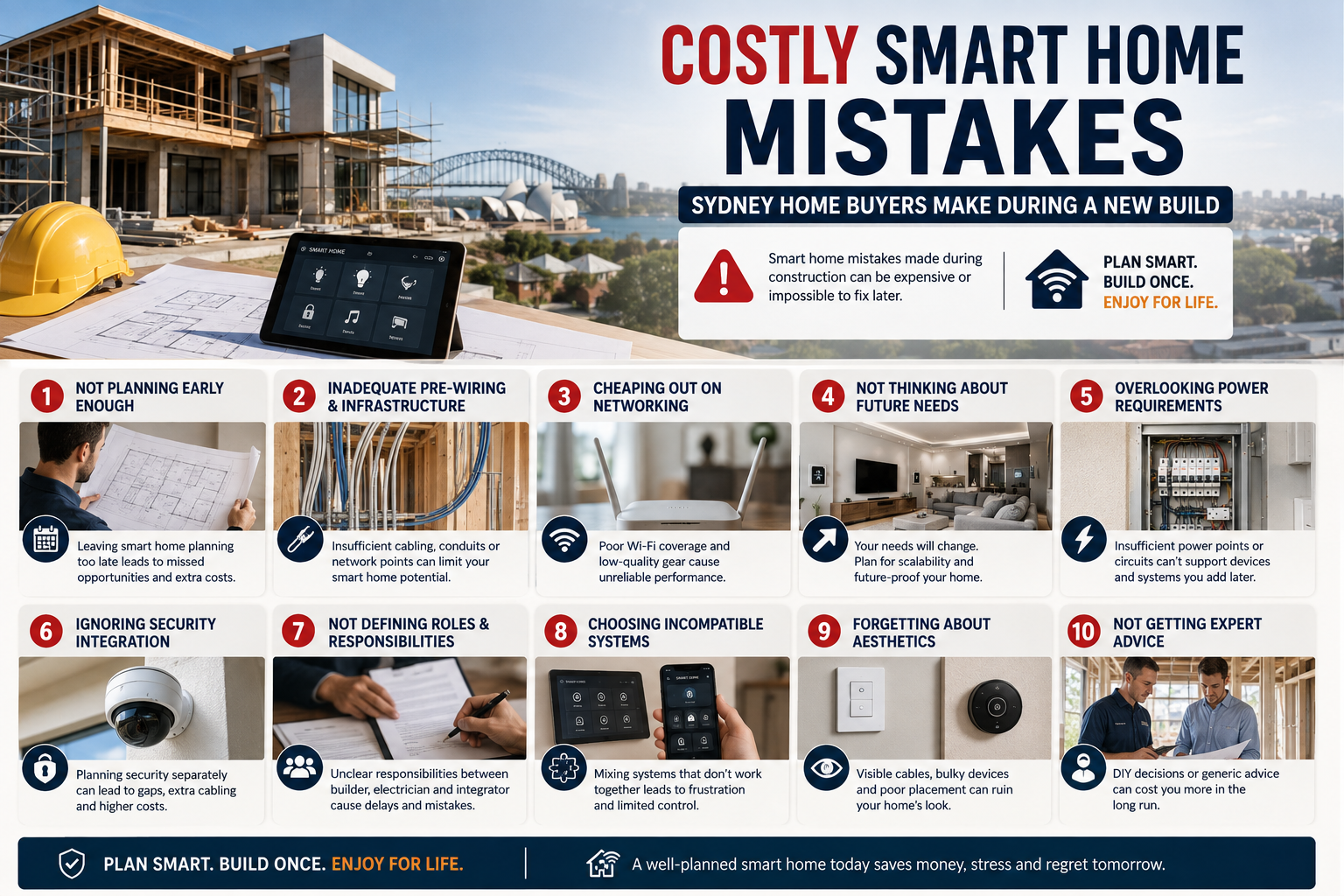
5 Costly Smart Home Mistakes Sydney Home Buyers Make During a New Build.
Building a new home in Sydney is an exciting opportunity to create a property that matches your lifestyle, design preferences and future needs. It is also one of the best times to incorporate smart home technology because walls, ceilings and electrical systems are still being planned and installed.
However, many Sydney home buyers make the mistake of treating smart technology as something to add after construction.
By the time the home is finished, important opportunities for pre-wiring, network infrastructure, security, lighting automation, entertainment systems and future technology may already have disappeared. Retrofitting these systems can be more disruptive and potentially more expensive than planning them during construction.
A smart home does not have to be filled with expensive gadgets. The real value comes from having the right infrastructure, reliable connectivity and carefully integrated technology.
At Alpha Smart Homes, we help homeowners approach smart home planning from the beginning so technology can be incorporated into the property rather than added as an afterthought.
This guide explores five costly smart home mistakes Sydney home buyers should avoid during a new build—and what to do instead.
Why Smart Home Planning Should Start Before Construction
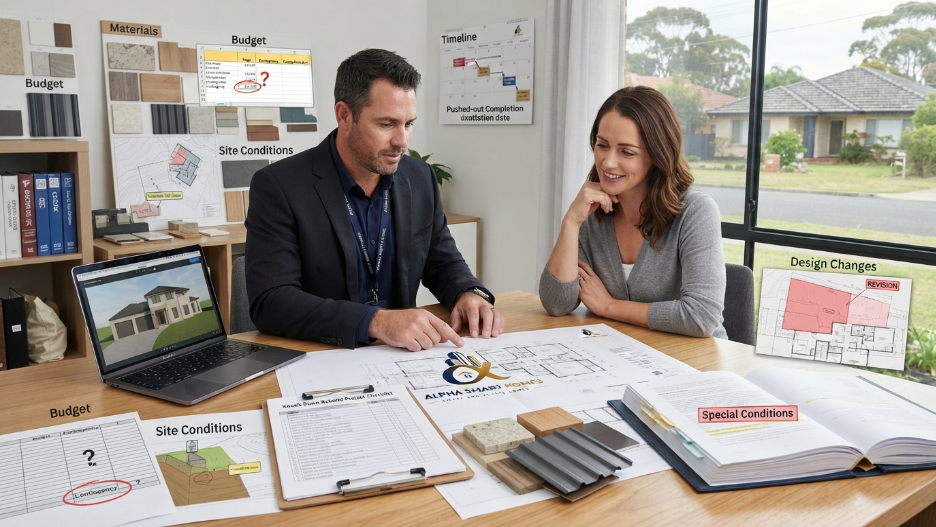
Before looking at the five mistakes, it is important to understand why timing matters.
During construction, electricians, builders and other trades have access to areas that will eventually be hidden behind walls, ceilings, cabinetry and finishes.
This creates an important opportunity.
Cables, conduits, network points, speaker wiring, security camera infrastructure and other provisions can be installed while access is easy.
Once the home is finished, the same work may require:
- Cutting into walls
- Removing ceiling sections
- Repainting
- Moving furniture
- Running visible cables
- Additional labor
- More complex installation methods
Not every smart technology requires hardwiring, but many systems benefit from early planning.
The goal is not to predict every device you will ever own.
The goal is to build a flexible foundation.
Mistake 1: Waiting Until the Home Is Finished to Plan Smart Technology
One of the most expensive mistakes is waiting until the construction process is almost complete before thinking seriously about smart home technology.
Homeowners sometimes assume they can simply move in and purchase smart devices later.
While some devices can certainly be added after construction, this approach can create limitations.
Why Waiting Can Become Expensive
Imagine deciding after moving in that you want:
- Security cameras around the property
- Ceiling speakers
- Better Wi-Fi coverage
- Automated blinds
- A home theatre
- Additional network outlets
- Smart access control
Some of these systems can be installed wirelessly.
Others may benefit significantly from dedicated cabling.
If the walls and ceilings are already finished, installers may need to find alternative cable routes or use visible solutions.
The result may be more expensive, less discreet or less flexible.
What to Do Instead
Start smart home planning during the design phase.
Ideally, discuss technology requirements before electrical plans are finalized.
Consider:
- Network points
- Wi-Fi access point locations
- Security camera positions
- Doorbell infrastructure
- Speaker locations
- Home theatre cabling
- Motorized blind provisions
- Smart lighting
- Central equipment locations
- EV charging provisions
- Future conduits
You do not need to purchase every device immediately.
You simply need to identify the infrastructure required to support your priorities.
Mistake 2: Focusing on Smart Devices Instead of Smart Infrastructure
The second major mistake is focusing too heavily on visible technology.
Homeowners often start their smart home research by comparing:
- Smart lights
- Smart speakers
- Smart locks
- Security cameras
- Smart TVs
- Smart appliances
These products are important, but they are only one part of a smart home.
The infrastructure behind the devices can be even more important.
Why Infrastructure Matters
Think of the home network as the foundation of the smart home.
If the network is unreliable, connected devices may become unreliable too.
A large Sydney home may contain dozens of connected devices.
These could include:
- Smartphones
- Computers
- TVs
- Security cameras
- Speakers
- Smart switches
- Appliances
- Sensors
- Gaming systems
- Home-office equipment
Relying on a single basic router may not provide the coverage or capacity required.
Build a Strong Network Foundation
A professionally planned smart home may include:
- Structured Ethernet cabling
- Strategically positioned Wi-Fi access points
- Network outlets
- Centralized network equipment
- Appropriate equipment locations
- Security camera connections
- Future network provisions
The exact requirements depend on the home’s size and technology plan.
Pre-Wiring Is About Future Flexibility
Pre-wiring can be particularly valuable for new builds.
For example, you may not currently want speakers in every room.
However, installing appropriate cabling during construction may allow you to add them later without major building work.
The same principle applies to cameras, network points and other technologies.
The Better Approach
Think about the home as infrastructure first and devices second.
Ask:
“What should this house be prepared for?”
Then determine which devices make sense today.
Mistake 3: Choosing Products Before Choosing an Overall System

Another common mistake is buying smart home products individually without considering how they will work together.
One product may use one platform.
Another may require a different application.
A third may not integrate properly with either.
Eventually, homeowners can end up with several separate apps and different control methods.
That is not necessarily a smart home.
It is a collection of connected products.
Why Compatibility Matters
Before purchasing smart technology, consider:
- Which systems need to communicate?
- How will they be controlled?
- Which devices are compatible?
- Can the system expand?
- What happens if one product is discontinued?
- Can the homeowner still use traditional controls?
- How easy will the system be to maintain?
A professional smart home design should address these questions before equipment is purchased.
Think in Terms of Scenes
A well-integrated smart home can coordinate multiple functions.
For example, a “Goodnight” scene might:
- Turn off selected lights
- Adjust climate settings
- Secure appropriate access points
- Activate selected security functions
A “Movie Night” scene could:
- Dim selected lights
- Close motorized blinds
- Activate entertainment equipment
- Adjust the room environment
These experiences require systems to work together.
Avoid Technology for Technology’s Sake
Not every smart product provides meaningful value.
A homeowner may not need smart technology in every appliance.
Instead, prioritize systems that solve genuine problems.
Good smart home design is not about maximum technology.
It is about maximum usefulness.
Mistake 4: Underestimating Security Camera and Access Control Planning
Security is one of the most important areas of a smart home, yet it is often planned too late.
Homeowners may initially think about cameras only after construction is complete.
By then, ideal camera positions and cable routes may be difficult to achieve.
Security Camera Pre-Wiring
During a new build, consider potential camera locations such as:
- Front entrance
- Driveway
- Garage
- Side access
- Rear entrance
- Outdoor entertaining areas
- Other appropriate access points
The number and placement of cameras should be based on the property’s layout and security objectives.
The goal is not to install cameras everywhere.
It is to create appropriate coverage.
Don’t Forget the Doorbell
Video doorbells can form part of a broader smart security strategy.
A connected doorbell can potentially allow homeowners to see and communicate with visitors remotely, depending on the product and configuration.
Its location should be considered during construction so power and connectivity requirements can be addressed appropriately.
Think Beyond Cameras
Smart security can also include:
- Smart locks
- Intercoms
- Motion sensors
- Alarm systems
- Garage access
- Gate controls
- Security lighting
- Mobile notifications
The strongest approach is to think about security as a complete system rather than a collection of individual cameras.
Mistake 5: Forgetting Future Technology
The fifth mistake is designing the home entirely around today’s needs.
Technology changes quickly.
A homeowner may not currently own an electric vehicle.
They may not need battery storage.
They may not want whole-home audio.
They may not require additional security cameras.
But that does not mean these technologies will never become relevant.
Future-Proofing Your Sydney Home
You cannot predict exactly what technology will exist ten years from now.
However, you can create infrastructure that makes future upgrades easier.
Potential future-ready provisions include:
- Spare conduits
- Additional network outlets
- Security camera cabling
- Speaker cabling
- EV charging provisions
- Suitable equipment locations
- Additional electrical provisions where appropriate
- Flexible technology pathways
The idea is simple:
Build flexibility into the home before access becomes difficult.
Bonus Mistake: Ignoring the Home’s Energy Strategy
Although the five mistakes above are the most common, energy management deserves special attention.
Australian homeowners are increasingly considering:
- Solar
- Battery storage
- EV charging
- Energy monitoring
- Smart appliances
- Efficient lighting
- Climate automation
These systems should not necessarily be planned independently.
For example, if you are building a new home and expect to purchase an EV later, it may make sense to consider charging requirements during electrical planning.
If you are installing solar and battery storage, energy monitoring can provide better visibility into household consumption.
Smart technology can help connect these systems into a broader energy strategy.
The Cost of Retrofitting Smart Home Technology
The exact cost of retrofitting varies significantly depending on the technology and property.
However, retrofitting can introduce several additional challenges.
Access
Installers may need to access completed walls and ceilings.
Appearance
Visible cables may be harder to avoid.
Labor
Additional time may be required to create suitable cable routes.
Disruption
Furniture, finishes and completed rooms may need to be disturbed.
Limited Placement
Technology may have to be installed where access is possible rather than where it would perform best.
This is why early planning is valuable.
It does not necessarily mean installing everything during construction.
It means installing the infrastructure when installation is easiest.
Smart Home Planning for Different Sydney Property Types
Sydney homes vary significantly.
The right smart home strategy depends on the property.
Large Family Homes
Large homes may require:
- Multiple Wi-Fi access points
- Structured network cabling
- Multi-zone lighting
- Security cameras
- Climate zoning
- Whole-home audio
Compact Homes
Smaller homes may benefit from:
- Smart lighting
- Security
- Reliable networking
- Smart access
- Climate automation
The system can remain simple while still providing meaningful benefits.
Multi-Story Homes
Multiple levels can create connectivity challenges.
Network access points and cabling should be planned carefully.
Security camera locations may also need to account for different elevations.
Renovation Projects
Renovations can provide opportunities to install new infrastructure while walls and ceilings are already being modified.
How to Avoid These Smart Home Mistakes
The easiest way to avoid costly mistakes is to use a structured process.
Step 1: Start Early
Discuss smart technology before construction decisions are finalized.
Step 2: Define Your Priorities
Determine which systems matter most.
Step 3: Review the Plans
Consider every room, outdoor area and access point.
Step 4: Plan Infrastructure
Identify network, security, audio and future cabling requirements.
Step 5: Select Compatible Technology
Choose systems that can work together.
Step 6: Coordinate With the Builder
Make sure technology requirements are communicated to the relevant trades.
Step 7: Install During the Appropriate Construction Stage
Pre-wire before walls and ceilings are closed.
Step 8: Test Everything
Commission the system before handover.
Step 9: Learn How to Use It
Make sure everyone in the household understands the basic controls.
Step 10: Keep Future Expansion in Mind
Leave room for technology upgrades.
Why Choose Alpha Smart Homes for Your Sydney New Build?
Choosing a smart home partner is about more than selecting products.
You need someone who understands how technology fits into the construction process.
Alpha Smart Homes takes a planning-led approach to smart home technology.
The process can involve:
Consultation
Understanding your lifestyle, goals and priorities.
Plan Review
Assessing the home’s architecture and identifying technology opportunities.
Infrastructure Planning
Determining where cables, conduits, network points and equipment should be located.
Technology Selection
Identifying appropriate products and systems based on compatibility and requirements.
Builder Coordination
Communicating relevant technology requirements during construction.
Installation
Installing equipment and infrastructure at the appropriate stage.
Programming
Configuring automation scenes and controls.
Testing
Checking system performance and integration.
Handover
Helping homeowners understand their new smart home.
This approach can help reduce the risk of expensive changes later.
A Practical Smart Home Checklist for Sydney New Builds
Before signing off on your home’s technology plan, consider the following:
- Have you planned your home network?
- Have you identified Wi-Fi access point locations?
- Have you considered Ethernet outlets?
- Have security cameras been planned?
- Is security camera pre-wiring included?
- Have you considered a video doorbell?
- Have you planned smart access control?
- Have lighting automation requirements been discussed?
- Have speaker locations been considered?
- Do you need home theatre infrastructure?
- Have motorised blind provisions been considered?
- Have EV charging requirements been discussed?
- Have solar and battery systems been considered?
- Is energy monitoring important to you?
- Have future technology provisions been planned?
- Is there a suitable location for network and automation equipment?
- Have the relevant requirements been communicated to your builder and trades?
- Will the finished system be tested before handover?
If several of these questions have not been answered, your smart home plan may not be complete.
Frequently Asked Questions
When should I start planning smart home technology for a new Sydney home?
Ideally, smart home planning should begin during the architectural and design stages. This allows technology requirements to be considered before electrical plans and construction decisions are finalised.
Is smart home pre-wiring worth it?
Pre-wiring can provide greater flexibility, particularly for security cameras, networking, audio, home theatre and future technologies. It can also help create a cleaner finished installation.
Do I need smart technology in every room?
No. Smart home technology should be based on your lifestyle and priorities. Some homeowners may benefit from whole-home automation, while others may only need smart networking, security and selected lighting.
Can I add smart technology after construction?
Yes, many smart devices can be installed later. However, some technologies can be more difficult or expensive to retrofit, which is why early infrastructure planning is valuable.
Should I choose the cheapest smart home products?
Price should not be the only consideration. Compatibility, reliability, support, scalability and long-term usability are also important.
What is the most important smart home infrastructure?
A reliable network and appropriate electrical and cabling infrastructure provide a strong foundation for many smart home systems. The exact requirements depend on the property’s design.
Can Alpha Smart Homes work with my new home builder?
Smart home projects often require coordination with builders, electricians and other trades. Early communication can help ensure infrastructure is installed at the correct stage of construction.
Build Smarter From the Beginning
A new home is a rare opportunity to create the infrastructure you want before the property is finished.
Do not wait until the walls are painted to decide where your security cameras should go.
Do not wait until you move in to discover that your Wi-Fi does not reach the garage.
Do not wait until you want a home theatre to discover that the required cabling was never installed.
And do not assume today’s technology requirements will remain the same forever.
The most effective smart homes begin with planning.
By avoiding the five major mistakes covered in this guide—waiting too long, ignoring infrastructure, choosing disconnected products, underplanning security and forgetting future technology—Sydney homeowners can create properties that are more connected, convenient and adaptable.
At Alpha Smart Homes, we believe smart home technology should be integrated into the building process rather than treated as an afterthought.
From network infrastructure and security camera pre-wiring to smart lighting, energy management, EV charging and future-ready technology, every decision should support the way you want to live.
Your smart home does not need to contain every device on the market.
It needs the right technology, the right infrastructure and the right plan.
If you are building a new home in Sydney, start planning your smart home before construction begins. Early decisions can help create a cleaner installation, better connectivity and a home that is prepared for the technology of tomorrow.