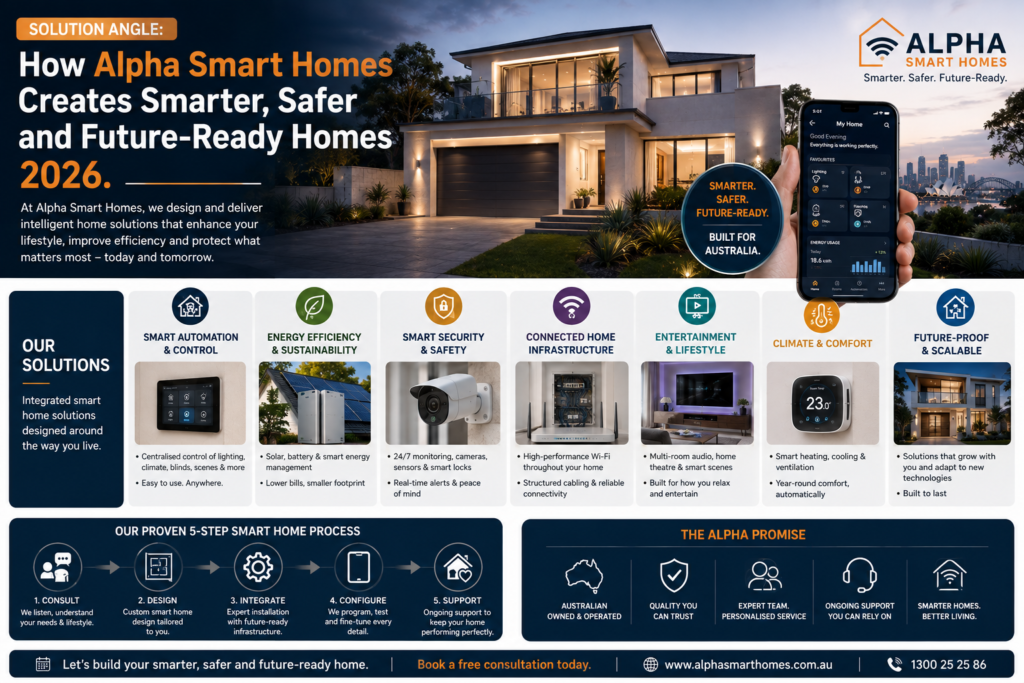
Solution Angle: How Alpha Smart Homes Creates Smarter, Safer and Future-Ready Homes 2026.
Solution Angle: A modern home is expected to do more than provide shelter. Homeowners increasingly want properties that are comfortable, secure, energy-conscious, connected and easy to manage. From automated lighting and intelligent security to reliable home networks, entertainment systems, energy monitoring and EV charging, technology is becoming an important part of the way Australians design and use their homes.
However, installing smart technology is not simply a matter of buying connected devices.
A home can contain dozens of smart products and still provide a frustrating experience if those products do not communicate properly, the network is unreliable, the controls are complicated or the infrastructure was not planned correctly.
This is where the right smart home partner can make a significant difference.
Alpha Smart Homes takes a solution-focused approach to smart home design and technology integration. Instead of starting with a list of gadgets, the process starts with the homeowner, the property and the problems that technology needs to solve.
The result is a smart home designed to provide practical value today while remaining adaptable for tomorrow.
Solution Angle: Whether you are building a new home, renovating an existing property or upgrading selected areas, a well-planned smart home can improve everyday convenience while supporting security, energy management, accessibility and long-term property value.
What Is a Smart Home Value Proposition?
Solution Angle: A value proposition explains why a particular solution is useful and what makes it valuable to the customer.
For smart home technology, the value is not simply that lights can be controlled from a smartphone.
The real value comes from what happens when multiple systems work together.
Solution Angle: A professionally designed smart home can help homeowners:
- Simplify everyday routines
- Improve visibility over home security
- Create more comfortable living environments
- Manage lighting more efficiently
- Improve connectivity
- Integrate entertainment
- Monitor energy use
- Prepare for electric vehicle charging
- Support changing household needs
- Create infrastructure for future technology
The focus should therefore move from “What devices can I install?” to “What problems can my smart home solve?”
Solution Angle: That solution-focused mindset is at the heart of effective smart home design.
The Alpha Smart Homes Difference (Solution Angle)
Solution Angle: The smart home market contains countless products, platforms and technologies.
Homeowners can easily become overwhelmed by choices.
One manufacturer offers smart switches. Another provides security cameras. Another sells automated blinds. Different systems may use different applications, communication protocols and control methods.
Buying everything separately can create a disconnected experience.
Alpha Smart Homes approaches the project from a broader perspective.
Instead of treating lighting, security, networking, entertainment and energy as completely separate projects, the goal is to consider how they can work together within the property.
This solution-based approach focuses on five fundamental principles:
1. Understand the Homeowner
Technology should reflect how the household actually lives.
2. Understand the Property
The home’s architecture, layout and construction affect technology requirements.
3. Build the Right Infrastructure
Reliable infrastructure creates a foundation for connected technology.
4. Integrate the Systems
Technology should work together where appropriate rather than creating unnecessary complexity.
5. Plan for the Future
A smart home should be able to evolve as technology and household needs change.
Solution 1: Simplifying Everyday Life
Solution Angle: One of the strongest benefits of smart home automation is convenience.
Modern households are busy. People work, study, manage children, prepare meals, entertain guests and move between different areas of the home throughout the day.
Smart automation can reduce repetitive tasks.
For example, instead of manually adjusting several lights every evening, homeowners can create predefined lighting scenes.
A “Morning” scene could activate selected lighting.
An “Entertaining” scene could coordinate indoor and outdoor lighting.
A “Movie” scene could dim selected lights while preparing the entertainment environment.
A “Goodnight” scene could turn off selected lights and activate appropriate security settings.
The purpose is not automation for its own sake.
Solution Angle: The purpose is to make everyday life easier.
Solution 2: Creating a More Secure Home
Solution Angle: Security is one of the most practical applications of smart home technology.
A modern smart security strategy can bring several systems together, potentially including:
- Security cameras
- Video doorbells
- Smart locks
- Motion sensors
- Alarm systems
- Gate controls
- Garage access
- Security lighting
- Mobile notifications
Instead of checking separate systems, homeowners can potentially manage key security functions through a more coordinated interface.
Security Camera Pre-Wiring
Solution Angle: For new homes, security camera pre-wiring can be particularly valuable.
Cabling can be installed during construction before walls and ceilings are completed.
This can provide a cleaner installation and reduce the need for visible cables later.
Potential camera locations may include:
- Front entry
- Driveway
- Garage
- Side access
- Rear entry
- Outdoor entertaining areas
Solution Angle: The exact requirements depend on the property and security objectives.
Solution 3: Reliable Home Connectivity
Smart homes depend on connectivity.
Even the most sophisticated automation system can become frustrating if the home’s network is poorly designed.
Today’s homes may have numerous connected devices, including:
- Smartphones
- Computers
- Televisions
- Smart speakers
- Security cameras
- Smart appliances
- Gaming systems
- Lighting controls
- Sensors
- Access control systems
Solution Angle: This makes home networking a fundamental part of smart home infrastructure.
Why Professional Network Planning Matters
Solution Angle: A single consumer router may not provide consistent coverage throughout a large or complex home.
A professionally planned network may use strategically positioned wired access points and network outlets to provide stronger connectivity.
This is particularly important for:
- Multi-story homes
- Large properties
- Home offices
- Media rooms
- Outdoor areas
- Homes with many connected devices
The solution is not simply “more Wi-Fi.”
It is better network planning.
Solution 4: Smarter Lighting
Solution Angle: Lighting affects the way a home looks, feels and functions.
Smart lighting can allow homeowners to control brightness, create scenes and automate selected areas.
Instead of turning every light on or off manually, homeowners can establish lighting behavior’s around daily routines.
Lighting Scenes
Consider a typical evening.
A homeowner arrives home and activates a “Welcome” scene.
Selected entry and living area lights turn on.
Later, an “Entertaining” scene activates additional lighting.
Solution Angle: When it is time to watch a movie, “Movie” mode reduces selected lighting levels.
At bedtime, “Goodnight” turns off unnecessary lights and activates appropriate night lighting.
These small improvements can make a noticeable difference to daily life.
Solution 5: Better Energy Awareness
Solution Angle: Energy management is becoming an increasingly important consideration for Australian homeowners.
Smart home technology can help homeowners understand how energy is being generated and consumed.
Depending on the system, homeowners may be able to monitor:
- Household electricity consumption
- Solar generation
- Battery status
- Major energy loads
- EV charging
- Usage patterns
The objective is not simply to display data.
Useful energy management should help homeowners make better decisions about how the home operates.
Solar and Battery Integration
Solution Angle: Homes with solar and battery systems may benefit from integrated monitoring and automation.
For example, homeowners may want greater visibility over when solar energy is generated, when batteries are charging and how major loads affect overall consumption.
Professional system planning can help bring these components together into a broader home technology strategy.
Solution 6: Preparing for Electric Vehicles
Solution Angle: Electric vehicle adoption is influencing the way new homes are designed.
Homeowners building today may purchase an EV in the future even if they currently drive a conventional vehicle.
That makes EV charging provisions worth considering during the planning stage.
A future-ready smart home may allow for:
- Appropriate electrical capacity
- Dedicated charging locations
- Cable pathways
- Garage connectivity
- Energy monitoring
- Potential integration with solar and battery systems
Planning early can help avoid unnecessary disruption later.
Solution 7: Better Home Entertainment
Solution Angle: Entertainment systems are another area where smart home integration can create significant value.
Instead of having separate remotes and controls for every component, a professionally designed system can bring selected functions together.
Potential systems include:
- Televisions
- Projectors
- Home theatre
- Distributed audio
- Streaming devices
- Speakers
- Lighting
- Motorized blinds
For example, activating a “Movie Night” scene could prepare the room by adjusting lighting and entertainment equipment.
The objective is a seamless experience.
Solution 8: Comfort Through Climate Automation
Solution Angle: Australian homes can experience significant temperature variations throughout the year.
Smart climate control can help homeowners manage heating, cooling and ventilation more conveniently.
Depending on the home’s systems, automation may allow selected areas to respond to schedules, occupancy or user preferences.
For example, the home could be configured around:
- Morning routines
- Work-from-home schedules
- Evening routines
- Sleeping hours
- Holiday periods
Solution Angle: The goal is to balance comfort, convenience and responsible energy use.
Solution 9: Supporting Independent and Multigenerational Living
Solution Angle: Australian homes increasingly need to accommodate changing family structures.
A home may be designed for children, parents, ageing family members or multiple generations.
Smart technology can support accessibility and independence through features such as:
- Automated lighting
- Voice control
- Smart locks
- Video intercoms
- Automated blinds
- Security notifications
- Centralized controls
- Simple lighting scenes
Solution Angle: For some households, these features can make everyday tasks easier and provide greater confidence.
The best solution is not necessarily the most technologically advanced system.
It is the system that is easiest and most useful for the people living in the home.
Solution 10: Future-Proofing the Property
Solution Angle: One of the biggest advantages of planning smart technology during construction is the opportunity to create flexible infrastructure.
Technology changes rapidly.
A homeowner may not know which devices they will want five or ten years from now.
Trying to predict specific future products is therefore less important than creating an infrastructure capable of supporting change.
Future-Proofing May Include
- Additional network outlets
- Spare conduits
- Accessible equipment locations
- Security camera provisions
- Audio cabling
- EV charging provisions
- Additional electrical capacity where appropriate
- Flexible control infrastructure
The principle is simple:
Plan the infrastructure today so the technology can evolve tomorrow.
The Problem With DIY Smart Home Installation
Solution Angle: DIY smart home products can be useful for individual applications.
A homeowner may install a smart bulb, smart speaker or connected plug without professional assistance.
The challenge begins when dozens of independent devices become part of one home.
Common problems can include:
Multiple Applications
Every system may require its own application.
Compatibility Problems
Not every device works naturally with every platform.
Weak Connectivity
Too many wireless devices can expose weaknesses in the home network.
Limited Expansion
A system designed around a few products may become difficult to expand.
Difficult Troubleshooting
When several independent products interact, identifying the source of a problem can become difficult.
Solution Angle: Professional smart home design aims to reduce these issues by considering the entire system before installation.
Smart Home Design Should Be Solution-First, Not Product-First
Solution Angle: A product-first approach begins with equipment.
A solution-first approach begins with a problem.
For example:
Problem: The homeowner struggles to manage exterior security.
Solution: Develop a coordinated security strategy using appropriate cameras, access control, lighting and notifications.
Another example:
Problem: The homeowner wants reliable internet throughout a large home.
Solution: Design structured network infrastructure and strategically positioned access points.
Another:
Problem: The homeowner wants easier evening routines.
Solution: Create automated lighting and appropriate scenes.
This approach ensures technology serves a purpose.
Why Infrastructure Is Part of the Value
Solution Angle: Homeowners often focus on visible technology.
However, much of the value of a smart home exists behind the walls.
Cabling, network infrastructure, equipment locations and future pathways may never be visible once the home is complete.
Yet they can determine how well the system performs.
Pre-Wiring Creates Flexibility
Solution Angle: Installing infrastructure during construction can be easier than retrofitting it later.
Potential pre-wiring applications include:
- Security cameras
- Network connections
- Speakers
- Home theatre
- Motorized blinds
- Control systems
- Future technology
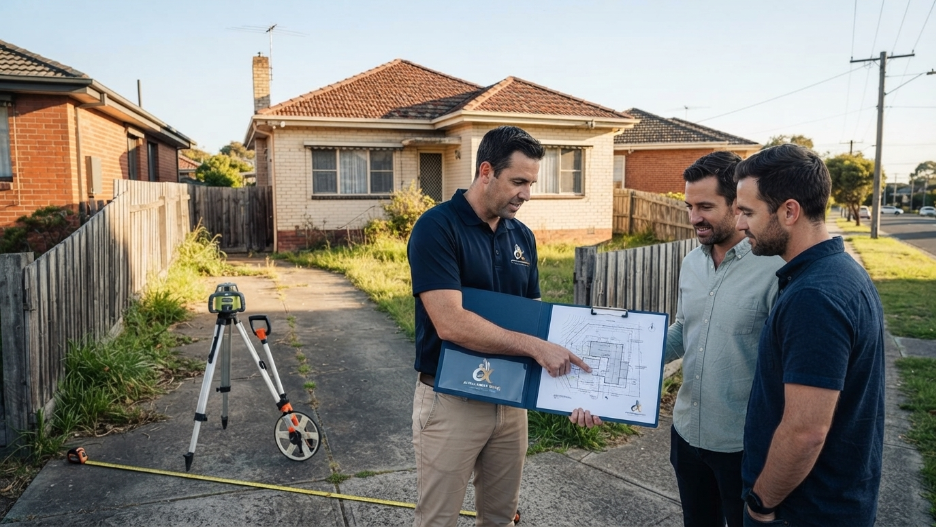
This is particularly important for new homes because walls and ceilings are accessible during construction.
Smart Home Technology and Property Value
Solution Angle: Technology should not be installed solely because someone believes it will increase resale value.
However, a thoughtfully designed smart home can contribute to the overall appeal of a property.
Potential advantages include:
- Modern functionality
- Improved security
- Better connectivity
- Energy monitoring
- Convenient lighting control
- Integrated entertainment
- EV readiness
- Future-ready infrastructure
Solution Angle: The strongest value comes from technology that is reliable, intuitive and professionally integrated.
A complicated system that homeowners cannot operate comfortably may provide less practical value than a simpler system that works consistently.
A Scalable Approach to Smart Home Investment
Solution Angle: Not every homeowner needs a fully automated property on day one.
A scalable approach allows the system to grow.
Foundation
Start with:
- Network infrastructure
- Security provisions
- Electrical planning
- Future pathways
Core Automation
Add:
- Lighting
- Climate
- Access control
- Security integration
Lifestyle Systems
Then consider:
- Home theatre
- Whole-home audio
- Automated blinds
- Advanced scenes
Future Technologies
Finally, integrate:
- EV charging
- Energy management
- Additional automation
- New connected devices
Solution Angle: This approach allows homeowners to prioritize spending while preserving future opportunities.
Why Choose Alpha Smart Homes?
Solution Angle: The value of a smart home integrator is not simply in supplying hardware.
It is in bringing together the different parts of the project into a coherent solution.
Alpha Smart Homes focuses on the relationship between:
Home + Lifestyle + Infrastructure + Technology + Future Needs
This approach helps homeowners make technology decisions based on practical requirements rather than marketing trends.
A professional smart home solution should aim to deliver:
Simplicity
Technology should make the home easier to operate.
Reliability
Critical systems should be designed with dependable infrastructure.
Integration
Where appropriate, systems should communicate and operate together.
Scalability
The system should have room to grow.
Aesthetics
Technology should complement the home’s architecture.
Practical Value
Solution Angle: Every major technology investment should solve a genuine need.
What the Alpha Smart Homes Process Can Deliver
Solution Angle: A solution-focused project may include:
Consultation
Understanding the homeowner’s goals, lifestyle and priorities.
Planning
Reviewing architectural plans and identifying technology requirements.
Infrastructure
Designing network, cabling, security and future-ready provisions.
Integration
Connecting appropriate systems into a cohesive smart home environment.
Installation
Installing the selected equipment carefully and professionally.
Programming
Creating scenes, automation and controls around the homeowner’s routines.
Testing
Checking system functionality and integration.
Handover
Helping homeowners understand how to operate their smart home.
Future Support
Solution Angle: Allowing the system to evolve as needs and technologies change.
This end-to-end approach creates a clearer pathway from concept to completed smart home.
Who Can Benefit From a Smart Home Solution?
Solution Angle: Smart home automation is not limited to luxury properties.
Families
Security, lighting and convenient routines can simplify busy households.
Professionals
Reliable networking, automated lighting and climate control can support work-from-home environments.
Homeowners Building New Properties
New construction provides opportunities for comprehensive pre-wiring and future-ready infrastructure.
Renovators
Technology can be integrated during major renovations.
Older Homeowners
Automation and accessibility features can help make everyday activities easier.
Multigenerational Families
Centralised controls and security systems can support different household requirements.
Technology Enthusiasts
Advanced automation can create highly customised home environments.
The right system depends on the household rather than the label attached to the property.
Frequently Asked Questions
What makes Alpha Smart Homes different from buying smart devices myself?
The difference is the solution-based approach. Instead of simply installing individual products, a professional smart home project considers the home’s infrastructure, network, automation, security and future requirements as a connected system.
Is a smart home only suitable for luxury properties?
No. Smart home technology can be scaled according to the property and budget. Homeowners can begin with essential infrastructure and core automation before expanding the system over time.
Should I install smart home technology during construction?
For new homes, early planning is highly beneficial. Pre-wiring and infrastructure can be installed while walls and ceilings are accessible, potentially making future installation easier and cleaner.
What is the most important smart home investment?
There is no single answer for every property. Network infrastructure, electrical planning and appropriate pre-wiring can provide a strong foundation, while the best automation systems depend on the homeowner’s priorities.
Can my smart home grow over time?
A properly planned system can be designed for future expansion. Additional rooms, security devices, entertainment systems, EV charging and other technologies can potentially be incorporated later.
Does smart home automation make a home more complicated?
Poorly designed automation can. Good automation should do the opposite. The purpose is to simplify everyday tasks through intuitive controls, scenes and coordinated systems.
The Real Value of a Smart Home Is How It Makes Life Better
The smartest home is not necessarily the one with the greatest number of devices.
It is the one where technology works quietly in the background, solving everyday problems without demanding constant attention.
A successful smart home can help you arrive home more comfortably, secure the property more confidently, manage lighting more conveniently, stay connected, enjoy entertainment more easily and understand energy consumption more clearly.
For Australian homeowners, these benefits become even more valuable when the system is designed around the property’s specific requirements.
At Alpha Smart Homes, the focus is on delivering practical technology solutions rather than simply adding smart products.
From the first consultation to infrastructure planning, installation, programming and future upgrades, the objective is to create a home that is connected, reliable, intuitive and ready for the future.
If you are building or renovating a home in Sydney or elsewhere in Australia, the best time to consider smart home technology is before construction decisions become difficult to change.
Start with your lifestyle.
Identify your problems.
Plan the infrastructure.
Choose the right technology.
Integrate the systems.
And build a smart home that provides genuine value every day.


Leave A Comment