

Targeted Local Guide: Building a Smart Home in Sydney 2026.
Local Guide: Building a new home is one of the biggest investments you will make, and choosing the right technology early can make a significant difference to comfort, security, energy efficiency and long-term value. For homeowners across Sydney and surrounding regions, smart home technology is no longer simply about having a few connected lights or controlling your television from a phone. A well-designed smart home can integrate lighting, climate control, security, entertainment, energy management, access control and future technologies into one practical system.
However, smart home requirements can vary significantly depending on where you live, the type of property you are building and the way your household uses the home. A family building in a growing western Sydney suburb may have different priorities from a homeowner renovating an established property on Sydney’s Lower North Shore. Similarly, a large new home in the Hills District may require a different technology infrastructure from a compact home in the Inner West.
Local Guide:This targeted local and regional guide explains what Sydney homeowners should consider when planning a smart home and how regional factors can influence the design. With the right planning and professional guidance from Alpha Smart Homes, homeowners can create a technology-ready property designed around their lifestyle rather than adding disconnected devices after construction.
Why Local Planning Matters for a Smart Home
Local Guide: Smart home technology should not be treated as a one-size-fits-all solution.
Sydney is a large and diverse metropolitan area with established suburbs, new residential developments, coastal properties, high-density areas and rapidly expanding growth corridors. Each environment presents different opportunities and challenges for home technology.
For example, a new build in a developing estate may provide an excellent opportunity to install structured cabling, security camera infrastructure, Wi-Fi access points, smart lighting controls and electrical provisions before the walls are closed. An established property may require more careful consideration of existing wiring, building structure and renovation limitations.
Local Guide: Local planning also matters because the physical characteristics of a property can influence technology performance. Home size, floor layout, construction materials, outdoor areas and the number of levels can all affect wireless connectivity, security coverage and climate-control requirements.
Instead of asking, “What smart devices should I buy?”, homeowners should begin with a more useful question:
“What technology infrastructure does my home need for the way I live?”
Local Guide: That change in approach can result in a smarter, more reliable and more future-ready home.
Smart Home Planning for Western Sydney
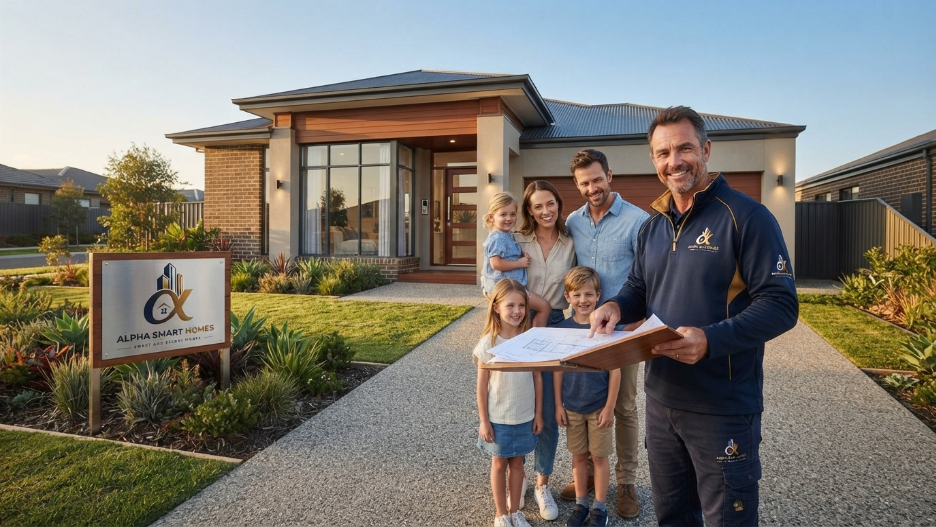
Local Guide: Western Sydney continues to experience substantial residential development, making it an important area for new-home construction and technology planning.
Local Guide: Suburbs and growth areas across Western Sydney can include newly developed estates, larger family homes and properties designed for modern family lifestyles. For these homes, infrastructure planning during construction can provide major advantages.
Prioritize Connectivity
Local Guide: A larger home can create challenges for conventional Wi-Fi. Multiple floors, large living areas, garages, outdoor entertaining spaces and building materials can reduce wireless performance.
Local Guide: Homeowners should consider installing a structured network with strategically positioned network outlets and ceiling-mounted wireless access points.
Rather than relying on a single router, a professionally planned network can provide more consistent connectivity throughout the home.
Plan Security Early
Local Guide: Security is another major consideration for properties in expanding residential areas.
A smart security strategy may include:
- Security camera pre-wiring
- Video doorbells
- Smart locks
- Motion sensors
- Alarm integration
- Gate and garage control
- Network infrastructure for security devices
- Mobile security notifications
Local Guide: Installing the infrastructure during construction can provide a cleaner result than adding visible cables and equipment later.
Prepare for Outdoor Living
Local Guide: Many Western Sydney homes are designed around outdoor entertaining. This creates opportunities for integrated outdoor lighting, entertainment, Wi-Fi coverage, security cameras and smart irrigation.
Planning these requirements before construction allows cables and connection points to be positioned where they are actually needed.
Smart Homes in Sydney’s Hills District
Local Guide: The Hills District includes many large family properties where technology can be integrated into extensive floor plans.
Homes with multiple living zones, several bedrooms, home offices, media rooms and outdoor spaces can benefit from centralized control.
Multi-Zone Lighting
Local Guide: Instead of controlling every light independently, homeowners can create lighting scenes for different activities.
For example:
Entertaining mode:
Living areas, kitchen and outdoor lighting activate together.
Movie mode:
Selected lights dim while the entertainment system activates.
Night mode:
Hallway and selected pathway lighting operate at lower levels.
Away mode:
Selected lights can simulate occupancy while security systems remain active.
These scenes can make large homes easier to manage while reducing unnecessary interaction with individual switches.
Climate Control
Local Guide: Large homes can also benefit from intelligent climate management. Smart controls can help homeowners manage different zones according to occupancy and daily routines.
For example, bedrooms may require different temperature settings from living areas, while unused rooms can operate differently when nobody is home.
Local Guide: The objective should not simply be to automate everything. Good smart home design should make the property easier and more efficient to operate.
Smart Home Considerations for Sydney’s Northern Suburbs
Local Guide: Sydney’s Northern Suburbs include a mixture of established homes, renovations and premium new builds. These properties often place a strong emphasis on design, comfort and discreet technology.
For homeowners building or renovating in these areas, invisible smart technology can be particularly valuable.
Keep Technology Visually Discreet
Local Guide: Smart technology does not have to dominate the interior design.
Instead of installing multiple visible devices, homeowners can consider:
- In-wall control panels
- Concealed speakers
- Recessed access points
- Discreet security cameras
- Automated blinds
- Hidden wiring
- Centralized equipment racks
- Integrated lighting controls
Local Guide: This approach allows technology to support the architecture without becoming the visual focus of the room.
Home Entertainment
Local Guide: Large living spaces can also benefit from integrated audio-visual systems.
A properly designed system can combine televisions, projectors, speakers, streaming services and lighting into a simple user experience.
For example, a single “Movie Night” scene could coordinate lighting and entertainment equipment without requiring homeowners to operate several remote controls.
Smart Homes in Sydney’s Eastern Suburbs

Local Guide: Properties in Sydney’s Eastern Suburbs can present unique challenges because many homes are located on established blocks with renovations, extensions or architectural considerations.
Local Guide: In these situations, technology planning should work alongside the building and interior design strategy.
Renovation-Friendly Smart Technology
Local Guide: When renovating an existing home, homeowners should consider which technologies require physical infrastructure and which can be installed with minimal structural changes.
Local Guide: Hardwired systems can often provide reliability and long-term flexibility, while wireless technologies may be useful where extensive cabling is impractical.
A professional assessment can help determine where each approach makes sense.
Security and Access
Local Guide: Security can be particularly important for homes with multiple entrances, garages, side access and outdoor areas.
Smart access control can potentially integrate:
- Main entrances
- Garage doors
- Gates
- Intercoms
- Video doorbells
- Smart locks
- Security notifications
Local Guide: The goal is to create one coordinated security strategy rather than a collection of unrelated products.
Smart Home Planning for Sydney’s Inner West
Local Guide: Inner West properties often have different characteristics from large suburban homes. Renovations, extensions, heritage considerations and compact floor plans can influence the technology strategy.
Wireless technology can be useful in some areas, but homeowners should still think carefully about network infrastructure.
Don’t Underestimate Network Planning
Even a smaller home may contain numerous connected devices, including:
- Smart lights
- Televisions
- Phones
- Computers
- Security cameras
- Smart appliances
- Speakers
- Gaming systems
- Sensors
- Smart locks
Local Guide: As the number of devices increases, a poorly planned network can become a major source of frustration.
A reliable home network should therefore be treated as part of the home’s infrastructure, not an afterthought.
Smart Homes in Sydney’s Northern Beaches and Coastal Areas
Local Guide: Coastal homes can have specific environmental considerations, particularly when technology is installed outdoors.
Local Guide: Outdoor equipment should be selected and positioned appropriately for the property’s environment. Security cameras, access points, lighting controls and entertainment equipment should be planned with exposure, location and maintenance requirements in mind.
Outdoor Connectivity
Local Guide: A smart coastal home may require reliable connectivity across:
- Patios
- Balconies
- Gardens
- Pool areas
- Driveways
- Garages
- Outdoor kitchens
- Entertaining areas
Local Guide: Planning network access and electrical provisions early can make these areas significantly easier to integrate.
Pool and Outdoor Automation
Local Guide: Where appropriate, smart technology can also assist with managing outdoor environments.
Potential applications include automated lighting, pool-related controls, irrigation and outdoor entertainment.
However, all electrical and automated systems should be designed and installed according to applicable Australian requirements and by appropriately qualified professionals.
Smart Homes in Sydney’s Growth Corridors with Local Guide

Local Guide: Sydney’s growth corridors provide one of the best opportunities to plan smart technology from the beginning.
New construction means homeowners can make infrastructure decisions before walls, ceilings and cabinetry are completed.
This is the ideal stage to consider:
- Structured cabling
- Network outlets
- Wi-Fi access point locations
- Security camera cabling
- Smart lighting circuits
- Home theatre wiring
- Speaker cabling
- Motorized blind provisions
- EV charging provisions
- Solar and battery infrastructure
- Central equipment locations
Why Pre-Wiring Matters
Local Guide: Pre-wiring involves installing cables, conduits and connection points during construction before they become difficult or expensive to access.
Local Guide: Even if homeowners do not immediately install every smart technology system, pre-wiring can preserve future options.
For example, you may not need outdoor security cameras on day one. But installing the required cabling during construction can make future installation significantly easier.
The same principle applies to home theatre systems, distributed audio, additional access points and other technologies.
Planning for EV Charging
Electric vehicles are becoming increasingly relevant to new-home planning.
Homeowners building a new property should consider whether they may eventually need an EV charger, even if they do not currently own an electric vehicle.
An EV-ready home may require appropriate electrical capacity, cable pathways and a suitable charging location.
The garage is often the logical location, but the exact requirements depend on the property, electrical design and vehicle needs.
Planning this during construction can help avoid unnecessary future disruption.
Solar, Battery and Energy Management
Energy management is another important part of modern smart home planning.
A connected home may combine solar generation, battery storage, energy monitoring and smart electrical loads.
This can give homeowners greater visibility into how and when energy is being used.
A smart energy strategy may help homeowners understand:
- Solar generation
- Household consumption
- Battery status
- Peak usage
- Major electrical loads
- EV charging
- Energy-saving opportunities
The most effective approach is to consider energy systems as part of the broader smart home design rather than treating each system separately.
Security Camera Pre-Wiring
Security cameras are one of the most practical systems to plan during a new build.
Instead of installing cameras later with exposed cabling, homeowners can establish dedicated connection points during construction.
Camera locations should be considered around areas such as:
- Front entrances
- Driveways
- Garages
- Side access
- Rear entrances
- Outdoor entertaining areas
- Other appropriate access points
The exact number and positioning of cameras should be determined based on the home’s layout and security requirements.
Designing for Multigenerational Living
Modern Australian homes increasingly need to accommodate changing household requirements.
A property may eventually need to support children, parents, ageing family members or guests.
Smart home technology can contribute to accessibility and independent living through features such as:
- Automated lighting
- Smart locks
- Video intercoms
- Voice controls
- Automated blinds
- Security notifications
- Environmental monitoring
- Simple centralized controls
The objective should be to make technology easier to use rather than making the home unnecessarily complicated. This approach ensures homeowners invest in technology that actually supports their property.
Why Choose Alpha Smart Homes?
Choosing the right smart home partner is about more than purchasing devices.
At Alpha Smart Homes, the focus is on planning technology around the home, the homeowner and the long-term purpose of the property.
A professional smart home strategy can help coordinate different technology requirements before construction decisions become difficult to change.
The process may include consideration of:
- Home layout and architectural plans
- Lifestyle requirements
- Lighting and electrical requirements
- Network infrastructure
- Security systems
- Entertainment requirements
- Energy management
- EV charging provisions
- Future technology
- Budget and priorities
This integrated approach helps reduce the risk of installing disconnected systems that do not work well together.
Smart Home Technology Should Be Future-Ready
Technology changes quickly. A home designed around today’s devices may become outdated if there is no infrastructure for future upgrades.
Future-ready planning does not necessarily mean installing every available smart device.
Instead, it means creating an adaptable infrastructure.
That could include spare conduits, additional network points, suitable equipment locations and flexible electrical provisions.
The principle is simple:
Build the infrastructure once, then upgrade the technology when needed.
This can be particularly valuable during new construction because accessing walls and ceilings becomes considerably more difficult after the home is completed.
Common Smart Home Planning Mistakes in Sydney
1. Waiting Until Construction Is Finished
One of the most common mistakes is treating smart technology as an installation that happens after the build.
Many infrastructure decisions are easier before walls are closed.
2. Relying Entirely on Wi-Fi
Wireless devices are convenient, but a large smart home can contain dozens or even hundreds of connected devices.
Critical systems may benefit from a properly planned wired network.
3. Ignoring Future Technology
Homeowners may not currently need an EV charger, additional cameras or a home theatre system.
However, planning for future requirements can save significant time and expense.
4. Buying Devices Before Planning the System
Purchasing individual smart products without considering compatibility can result in multiple apps, inconsistent controls and poor integration.
A system-first approach is generally more effective.
5. Forgetting Outdoor Areas
Driveways, garages, gardens and entertaining spaces are often overlooked during initial planning.
These areas should be considered as part of the complete smart home environment.
A Practical Sydney Smart Home Planning Checklist
Before construction or renovation begins, homeowners should consider the following:
- Identify the main purpose of the smart home.
- Review architectural and electrical plans.
- Plan the home network.
- Identify Wi-Fi access point locations.
- Plan security camera positions.
- Consider smart access control.
- Decide which lighting systems should be automated.
- Consider climate-control requirements.
- Plan home entertainment infrastructure.
- Assess outdoor connectivity.
- Consider EV charging provisions.
- Review solar and battery requirements.
- Plan central equipment locations.
- Allow for future cabling and upgrades.
- Establish a realistic technology budget.
- Confirm installation requirements with qualified professionals.
Frequently Asked Questions
What is a targeted local smart home guide?
A targeted local smart home guide explains how regional and property-specific factors can influence smart home planning. For Sydney homeowners, considerations may vary according to location, property size, construction type, lifestyle and future technology requirements.
Is smart home pre-wiring worth it for a new build?
Pre-wiring can provide valuable flexibility because cables and connection points can be installed while walls and ceilings are accessible. This can make future technology upgrades easier.
Should I use wired or wireless smart home technology?
Both can have a place in a modern smart home. Wired infrastructure can provide strong foundations for networks and critical systems, while wireless technology can offer flexibility. The best combination depends on the property and intended systems.
Should I plan for an EV charger before building?
If you are building a new home, it is worth considering future EV charging requirements. Even if you do not currently own an electric vehicle, planning the necessary electrical infrastructure early may provide greater flexibility later.
Can smart technology be added to an existing Sydney home?
Yes. Existing homes can use a combination of wired and wireless technologies depending on the building structure and renovation scope. A professional assessment can help determine the most practical approach.
How much does a smart home cost in Sydney?
The cost varies significantly depending on the home’s size, technology requirements, automation level, infrastructure and equipment selected. The best approach is to establish priorities and develop a technology plan that aligns with the overall construction budget.
Build a Smarter Home for Your Sydney Lifestyle
A smart home should be designed around the people who live in it and the property they live in.
Whether you are building a new home in Western Sydney, renovating in the Inner West, developing a larger property in the Hills District or planning a coastal home around Sydney’s Northern Beaches, local conditions and property characteristics should influence the technology strategy.
The most important decisions often happen before the first smart device is installed. Network infrastructure, pre-wiring, security provisions, electrical capacity, entertainment requirements, EV charging and energy systems can all benefit from early planning.
For Sydney homeowners, the goal should not simply be to create a house filled with connected devices. The goal is to create a reliable, practical and future-ready smart home that works naturally with everyday life.
With professional planning from Alpha Smart Homes, homeowners can approach smart home technology as part of the building process rather than an afterthought.
From pre-wiring and connectivity to security, lighting, energy management and future technology, the right strategy can help transform a new Sydney property into a home that is more comfortable, connected and prepared for tomorrow.
Planning a new smart home in Sydney? Start with the infrastructure, define your priorities and design the technology around your lifestyle.


Leave A Comment